After more than a month sailing around the world from where they were made in Shanghai, four 1,600-ton container gantry cranes recently arrived at the Napoleon Avenue Container Terminal at the Port of New Orleans (Port NOLA).
With the arrival of the gantry cranes, Port NOLA will be able to handle ships in the 8,000-to-9,500-TEU range more efficiently.
“Containerized cargo has more than doubled over the last decade at Port NOLA, and this investment positions Louisiana to grow as a major economic engine and job creator,” Gov. John Bel Edwards said in a statement.
The four, 100-foot tall cranes, unveiled during a ceremony Friday, are scheduled to begin work at the Napoleon Avenue Container Terminal early next year.
China-based Shanghai Zhenhua Heavy Industries Co. LTD manufactured the cranes. It delivered them on Thursday. The cranes are fully electric with zero diesel emissions and can reach containerized cargo stacked 20 containers high across any ship.
The four new cranes are essential to Port NOLA’s overall expansion, which includes optimizing facilities in New Orleans and building the $1.5 billion Louisiana International Terminal, a 350-acre container terminal, in St. Bernard Parish.
“This investment makes Port NOLA more competitive in the global trade-based economy and increases efficiency through the Louisiana gateway and helps fuel our economy,” said Brandy Christian, Port NOLA’s president and CEO.
Port NOLA’s total trade with the world was $13.4 billion in October, an increase of 34% from the same month a year ago. Exports increased 29% while imports rose 40%.
Port NOLA ranked No. 7 for total trade in October among the nation’s roughly 450 airports, seaports and border crossings, according to a WorldCity analysis of U.S. Census Bureau data. It had ranked No. 9 for the same month last year.
Port NOLA’s top three exports in October were soybeans, civilian aircraft and parts, and cell phones and related equipment.
The port’s top three imports were gasoline and other fuels, plasma/vaccines/blood and returned exports, without change.
New Orleans dry van outbound tender rejection rates were 18.34% this past weekend as outbound freight volumes remained flat at 44.20 index points.
To learn more about FreightWaves SONAR, click here.
On this episode of DecisionPoint, Carl reviews our exclusive DecisionPoint indicators, followed by an analysis of Bitcoin, 10-Year Treasury Yield, Bonds, Gold, Crude Oil and the Dollar. This week, he talks about participation using the Golden Cross Index (GCI) and Silver Cross Index (SCI) across the broad market indexes. Spoiler alert: They don’t look good. Erin then gives us a “bias assessment” of the Nasdaq. She reviews the Sector CandleGlance and an Industry Group CandleGlance. Don’t miss her two “Diamonds of the Week”!
This video was originally recorded on December 13, 2021. Click anywhere on the DecisionPoint logo above to view on our dedicated show page, orclick this linkto watch on YouTube. You can also watch this episode and other past episodes on the StockCharts on demand video service,StockChartsTV.com. Registration is free!
New episodes of DecisionPoint air on Mondays at 7pm ET on StockCharts TV. Archived episodes of the show are available atthis link.
About the author: Carl Swenlin is a veteran technical analyst who has been actively engaged in market analysis since 1981. A pioneer in the creation of online technical resources, he was president and founder of DecisionPoint.com, one of the premier market timing and technical analysis websites on the web. DecisionPoint specializes in stock market indicators and charting. Since DecisionPoint merged with StockCharts.com in 2013, Carl has served a consulting technical analyst and blog contributor. Learn More
About the author: Erin Swenlin is a co-founder of the DecisionPoint.com website along with her father, Carl Swenlin. She launched the DecisionPoint daily blog in 2009 alongside Carl and now serves as a consulting technical analyst and blog contributor at StockCharts.com. Erin is an active Member of the CMT Association. She holds a Master’s degree in Information Resource Management from the Air Force Institute of Technology as well as a Bachelor’s degree in Mathematics from the University of Southern California.
Though the reasons for a Santa Claus rally are debatable, the main school of thought is that, because there is less institutional participation in the market as many take time off to travel, the stock market is left in the hands of the retail investors, which tend to be more hopeful and cheerier. However, this Christmas is far from average, laying doubt on the potential Christmas rally, which normally takes place in the last two weeks of December. With mixed information on the new variant and a weak supply of goods, shoppers could be less motivated to spend this holiday.
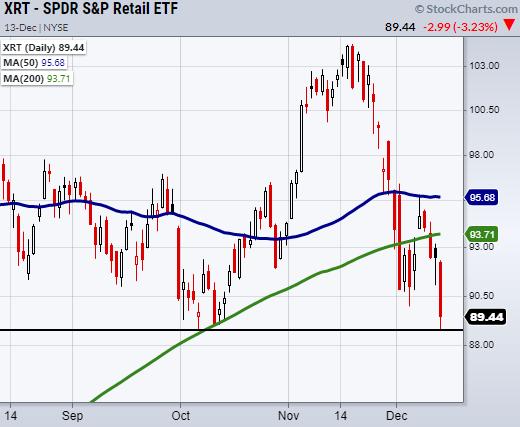
One worrying sign is from the retail sector (XRT), which is breaking under recent lows around $89.96. However, if the retail space is going to make a turnaround, it’s going to need to hold over $88.75.
Having said that, the retail space is not sticking out as the only weak sector. Looking at other key sectors within Mish’s Economic Modern Family, transportation (IYT), regional banking (KRE), and semiconductors (SMH) are also weak. This means that the retail space is not being singled out as prices are dropping across the board.
With that said, if there is going to be a Santa rally this year, we can watch for signs that XRT can hold these recent lows, along with other key sectors from the Modern Family.
Follow Mish on Twitter @marketminute for stock picks and more. Follow Mish on Instagram (mishschneider) for daily morning videos. To see updated media clips, click here.
On the latest editionofStockCharts TV’s Mish’s Market Minute, Mish gives you an overview of her favorite chart patterns that you can use to help you trade. She reviews flags, gaps, consolidation and wedges, just to name a few. This is an episode you’ll want to revisit many times.
ETF Summary
S&P 500 (SPY): 473.54 high to clear. 464.35 needs to hold.
Russell 2000 (IWM): 212.71 needs to hold.
Dow (DIA): 354.02 support. 365.64 highs to clear.
Nasdaq (QQQ): 401.19 to clear. Flirting with the 10-DMA at 392.16.
KRE (Regional Banks): 67.91 200-Day moving average next support.
SMH (Semiconductors): 297.89 watching to hold over.
IYT (Transportation): 274 to clear.
IBB (Biotechnology): Still trending lower.
XRT (Retail): Broke 89.96.
Forrest Crist-Ruiz
MarketGauge.com
Assistant Director of Trading Research and Education
About the author: Mish Schneider serves as Director of Trading Education at MarketGauge.com. For nearly 20 years, MarketGauge.com has provided financial information and education to thousands of individuals, as well as to large financial institutions and publications such as Barron’s, Fidelity, ILX Systems, Thomson Reuters and Bank of America. In 2017, MarketWatch, owned by Dow Jones, named Mish one of the top 50 financial people to follow on Twitter. In 2018, Mish was the winner of the Top Stock Pick of the year for RealVision.
The ability to retain present clients while attracting new ones is the biggest measure of success for any business—including third-party logistics (3PL) firms. Everyone knows that it’s more difficult to acquire new customers than to hold on to your existing customers—but new trends towards increasingly connected national transportation networks can make this tougher than ever. Any 3PL company that wants to survive and thrive must offer their current client more value by providing them real-time information and impeccable customer service.
It’s no secret that companies should always strive to build strong relationships with their clients. After all, trust is the foundation of all business relationships. The majority of retailers and other businesses will quickly look for alternatives whenever that trust is absent. Here are some reasons why shippers lose their trust in their 3PL partner and search for other logistics providers:
Broken promises: If you promise something and don’t follow through, your clients will be rightly uneasy about working with you in the future. It might mean that you are constantly promising capacity you don’t have or committing delivery windows you are unable to meet. To win a new contract or retain existing clients, some companies sign off on unachievable service level agreements (SLAs). In either case, not keeping your commitments has negative consequences for both the client and the logistics provider.
Inattention to customers: Often businesses think they are giving their current customers the right amount of attention, but their clients may feel otherwise. At the end of the day, this is usually a symptom of the same issue that causes broken promises: poor visibility. If you can’t tell what’s happening as your last mile deliveries actually unfold, you can’t easily visualize your network’s limitations. By the same token, you can’t give granular information to customers who might benefit from more insight into the delivery process.
Poor communication: If you fail to communicate frequently and accurately, you run the risk that customers will lose trust in you. You are, after all, carrying the brand into the last mile on behalf of your clients—they want to be confident that things are going well throughout the last mile delivery process. Crucially, communication isn’t just about keeping your clients in the loop; you need to keep end customers connected to the delivery process as well.
All these put together might suggest that the typical 3PL customer can be extremely demanding. In reality, however, they’re merely asking for service levels that will enable them to meet the high demands of their customers.
How To Keep Existing Clients and Gain New Ones
Maintain an unwavering commitment to customer service
Third-party logistics providers should constantly stress the importance of providing exceptional customer service in order to minimize potential client loss. Here are a few crucial things to focus on:
Contact and follow-up with customers promptly
Ensure that tracking information is sent to customers after shipments
Updating customers on order status regularly
Resolve order inaccuracies and returns quickly
Besides responding quickly to customer inquiries, 3PLs should do their best to provide customers with information and data proactively. 3PLs can always boost customer satisfaction by going above and beyond what is expected of it.
Ensure that your customers are always informed
Clients rely on third-party logistics providers to help ensure smoother, more seamless operations and deliveries. Using a 3PL allows them to remain focused on core competencies such as manufacturing, product design, and marketing, to name just a few. Clients are often reliant upon their 3PL partners to supply essential information including shipment tracking information and order updates.
That’s why it’s so important to provide timely and accurate information. The majority of companies that use 3PL services have customers of their own who typically require updates on their orders regularly. This means you have the opportunity to help your customers improve their own retention rates—as long as you’re able to to keep their customers in the loop throughout the delivery process.
Eliminate technological inefficiencies
There’s no getting around it: a 3PL’s efficiency and client retention may be adversely affected by outdated technology.
The client seldom empathizes with the cause of delayed delivery—especially when they are employing the services of 3PLs for their supply chain expertise. The last thing a customer wants is to worry about software systems not integrating with their 3PL provider’s systems or outdated route planning and dispatching solutions making the 3rd party logistics software less effective. Third-party logistics providers must ensure that their software systems are up to date and designed to work with the latest technology. That way, they can make life as easy as possible for retailers, distributors, manufacturers, and anyone else who might rely on their services.
How 3rd Party Logistics Software Can Ensure Customer Satisfaction
Implementing 3rd party logistics software is crucial for logistics providers who are focusing on their customer retention rates? Why? Because the right 3PL solutions enhance customer service, elevates your entire software ecosystem, optimizes logistics processes, and saves time and resources. Here’s a few things that an advanced 3rd party logistics solution should offer.
Software integration: Your 3rd party logistics software should have a flexible API as well as pre-built modules for easy synchronization across your entire 3PL solution ecosystem.
AI: The demand for tools that work with large amounts of data continues to increase constantly, especially among e-commerce firms. AI enables you to generate better predictions and improve operational processes.
Process tracking and improvement: Detecting potential exceptions and risks early and averting them are better than trying to track them down later. Implementing 3PL software that can make this possible helps maximize efficiency.
Cloud functionality: Using a cloud service can save resources and provide better stability in the short and long term. With the cloud, you don’t need to install additional equipment, maintain that equipment, or perform software upgrades manually. In a cloud ecosystem, accounting and ERP systems can be seamlessly integrated, and distributed networks can be managed more scalably regardless of company size
In the end, the best 3PL software will help you to consistently improve operations to strengthen relationships with current customers and stop them from switching to your competitors.
Spot freight volumes fell Thanksgiving week, but they have more than recovered.
Load board operator Truckstop.com reported its overall demand index fell by 12 points to 116.4 as load availability decreased 40.4%. But in the week after Thanksgiving, the index climbed to 122.9 as load availability increased 80.7%.
“Holiday weeks and holiday time off directly affects a transactional market like the spot market,” Brent Hutto, chief relationship officer at Truckstop.com, told Transport Topics. “The big change where you saw the market demand index go down by about 12 points and the daily load volumes go extremely down were just because people took time off.”
Hutto
Truckstop.com also reported that during the holiday week there was a 34.3% drop in the supply of trucks. So, despite high freight demand in general because of issues such as backlogs, there weren’t as many drivers on the spot market side. The supply of trucks bounced back by 71.2% during the next week.
“We had a daily high point on Thanksgiving week of only 835,000,” Hutto said. “We had one day that was 200,000 loads. That was Thanksgiving Day because people weren’t working for the most part.”
Flatbed led the recovery with load availability increasing 107.8% from the prior week. The one metric that went up during the holiday week was spot rates, which saw a 1.9% increase. Hutto explained that was a natural function of there being a lower supply of trucks creating more competitive rates. Spot rates then fell 0.2% that following week.
“When there are fewer trucks, the rates go up,” Hutto said. “Because a lot of truckers took time off to spend time with their families and their friends, there was less trucks on the road and rates went up. And by the way, that has happened every year.”
DAT Freight & Analytics found the number of spot load posts on its load board network increased 107% after the week of Thanksgiving and Black Friday. Truck posts increased 35%.
“It’s not usual to see big gains in loads and trucks posted when you compare a full workweek to one with a holiday, but 107% is significant and indicative of the high volume of freight moving in advance of the close of the month,” a DAT spokesperson told TT. “DAT iQ, the company’s analytics group, expects spot truckload rates to soften in the short term but to remain at elevated levels.”
DAT has been seeing around 25% of total truckload freight volume moving on the spot market when 12% to 15% historically is typical. The company also found that in the refrigerated sector there was strong demand for capacity leading up to Thanksgiving that continued in the week after. The reefer linehaul rate has been up year-over-year at about 55 cents in the $3-a-mile range.
Vise
“We did have a very healthy bounceback after Thanksgiving,” Avery Vise, vice president of trucking research at FTR, told TT. “Spot volumes were up about 80% last week, which is not tremendously unusual. We frequently see a pretty big boost.
“But I think it’s also important to note that dry van, in particular, is essentially, in the latest week, running at what I would call a record level.”
Vise added that dry van technically was at the third-largest week ever, but it was close to the second highest that occurred at the end of September. Vise noted the largest week was when a spike in volumes occurred in February. But he said that was an unusual situation given that widespread winter weather caused disruptions that led to a lot of spot market freight.
Host Mike Freeze talks to the 2021 Transport Topics Trucking’s Frontline Heroes, Gene Woolsey and Cully Frisard. Hear a snippet above, and get the full program by going to RoadSigns.TTNews.com.
“There are a couple of interesting things that happened,” Vise said. “One is we did not see, in the refrigerated segment, the typical run-up that we normally see right before Thanksgiving. Normally, the week before Thanksgiving is the strongest week of the year in the spot market for refrigerated and we really didn’t see that.”
Truckstop.com found that during the holiday week refrigerated load availability fell 35.7% and truck availability decreased 18.2%. Vise noted it is difficult to say whether that means anything given refrigerated volumes already have been high. He pointed to a couple of possible explanations such as load volumes being depressed because products didn’t make it to market.
“The other, I think more likely scenario, or at least certainly a part of that,” Vise said, “is that in anticipation of supply chain issues, we may have seen some front-loading of inventory builds that we typically would see much closer to Thanksgiving.”
On Monday, Bitcoin’s short-term outlook worsened after the price fell to an intra-day low at $45,672, a far cry from the weekend’s promising rally above the $50,000 level.
With the year nearly complete, and all-time highs nearly 33% away, traders are most likely readjusting their expectations and pushing the $100,000 BTC target a bit further into 2022.
Day traders, 4-hour chart watchers and over-leveraged longs are likely freaking out (unless they went short from $50,000 over the weekend or at this morning’s weakness), but let’s zoom out a little bit to see where Bitcoin price stands.
BTC/USDT daily chart. Source: TradingView
On the daily timeframe, we can see the price struggling to breakout away from the trend of daily lower highs and aside from the Dec. 4 drop to $42,000, traders appear apprehensive to buy into the most recent dips.
Tracking moving averages has always been a relatively simple way to swing trade BTC and currently the 20-day moving average (blue) is below the the 50-day MA (orange). Some traders simply buy when an asset secures a few daily closes above the 20-MA and sell when the price falls below it because this is a sign that the short-term trend is weakening.
Following this practice, momentum traders might wait for BTC to secure a daily close above the moving average at $53,000 before opening new long positions. More risk averse traders might consider waiting for convergence between the 20- and 50-MA as a clearer sign of a trend reversal. Taking a quick look at the last year of price action proves that the strategy is pretty effective.
Why some traders expect more downside
More experienced traders know that Bitcoin price has a tendency to make double tops, M-tops and head and shoulders patterns after hitting new all-time highs. Lately, analysts on crypto Twitter have pointed to what they perceive to be a double top, which is a clear trend reversal pattern.
BTC/USDT daily chart. Source: TradingView
Looking at the daily time frame, we can begin to see what looks like the start of a head and shoulders pattern. The current dips and following consolidation could eventually complete the right shoulder, with a neckline at $41,500, and a price target near a number so unbelievably low that it won’t be written here.
Traders will also notice that the neckline of said head and shoulders pattern aligns with a wide gap on the Volume Profile Visible Range (VPVR) indicator, which shows increased buying interest right at the $40,000 level.
At the moment, it’s too early to make too much fuss about the existence of a H&S pattern, especially since analysis of price action cannot be determined by a single indicator, but it is still something worth noting.
$BTC S/R update according to Volume Profile:
$47k has been a good support lately but if we break it, our next strong support is at $40k.
On the other hand, if we are able to break $50.6k resistance the next one is all the way at $56k.
Let’s see which set up is going to play out! pic.twitter.com/hcmvmUbVln
Data from an on-chain analysis outlet, Whalemap, also pinpoints the $40,000 level as an area to watch closely. While speaking to Cointelegraph, analysts at Whalemap said,
“Basically, if we start closing daily candles below the support outlined above, we will probably go to a lower one. The closest below us is around $40,000.”
While Bitcoin’s current price action does little to inspire confidence in traders who bought higher or expected price to trade in the $74,000 to $80,000 range in December, analyst Mohit Sorout recently pointed out that phases of negative funding have proven to be great buying opportunities.
On the daily timeframe the moving average convergence divergence (MACD) and Relative Strength Index (RSI) are also oversold, both of which have historically pointed to accumulation phases and good opportunities to dollar cost average into fresh long positions.
The views and opinions expressed here are solely those of the author and do not necessarily reflect the views of Cointelegraph.com. Every investment and trading move involves risk, you should conduct your own research when making a decision.
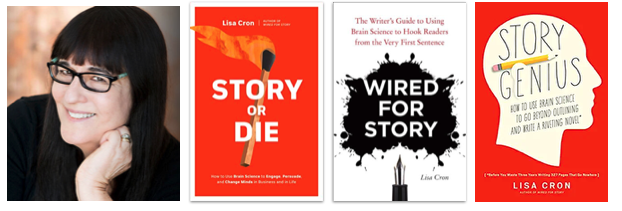
Why is story so important — no matter what genre we write? How can we use emotion to hook readers — and also tap into what matters in our own lives? Lisa Cron talks about these questions and more in this discussion about Story or Die.
Today’s podcast sponsor is Findaway Voices, which gives you access to the world’s largest network of audiobook sellers and everything you need to create and sell professional audiobooks. Take back your freedom. Choose your price, choose how you sell, choose how you distribute audio. Check it out at FindawayVoices.com.
You can listen above or on your favorite podcast app or read the notes and links below. Here are the highlights and the full transcript is below.
Why story is so important for humans — and why it’s present in every area of life
What stories are really about
The brain chemicals that a good story will activate — and how to write so they are triggered
Story principles in non-fiction
Emotion telegraphs meaning
The three biggest lies that are taught about writing
You can find Lisa Cron at WiredForStory.com and on Twitter @LisaCron
Transcript of Interview with Lisa Cron
Joanna: Welcome back to the show, Lisa.
Lisa: Thank you. It is an utter pleasure to be here.
Joanna: I’m excited to talk about this again. So, quoting from the book, you say, “Story far predates written language, and evolved as an essential survival tool, long before it was mis-classified as fiction,” which I love.
Why does story matter in every book we write, no matter the genre?
Lisa: Well, because first of all, story is story, regardless of genre, regardless of the format, whether you’re talking about a two-word tweet or War and Peace, it is always the same.
And it predates, really, everything. It really goes back to, if you want to think about it, our brains’ last, as we’ve all heard, big growth spurt, which was about 100,000 years ago. What we were taught, what evolutionary biologists thought for a long time, was that the reason for that growth spurt was because that was when we got the ability to think analytically. That analytic thought became possible at that time. And that’s true, it did.
But what they know now is that that wasn’t the reason for it. The reason for it was because by that time, and we were, at that time, in the middle of the food chain. And by that time, if we were going to leap to the front of the food chain, which we did, we needed to learn to do that thing that we’ve been told to do since kindergarten, since primary school, which is, we needed to learn to work well with others.
At that time, the need to belong to a group became as hardwired as is our need for food, air, and water. You often get people who go, ‘I’m a lone wolf. I don’t need anybody else. I’ve done everything on my own. I’m totally self-made.’ And I always want to go, ‘Well, you do know the wolves travel in packs.’
In the wolf community, a lone wolf is a wolf that has done something that was so egregious to the pack that they’re ostracized and left to die. The point is, is that we really are wired to need to work with other people and to band together in order to figure out literally how to survive.
That’s where story comes in, because story is the thing that lets us step out of the present, so we can envision the future and think about what would we need to do in order to survive the next wolf pack attack or saber-toothed tiger attack, or how to bring food together. And that’s really what stories are about.
At that time, it really became wired that stories aren’t just about how to solve something logistically, like how to survive a wolf attack.
Stories are really about how to survive in the social world.
When I say in the social world, I don’t just mean the world of dating. I mean literally the world of other people. Because that’s what we come to story for.
Now, for the past 100,000 years, and in every story, what we’re wired to come for is asking that question, ‘How is this going to help me make it through the night?’ How is it going to help me achieve my agenda, given what I want? Is it going to help me? Or is it going to hurt me?
And stories are, again, about the internal workings, literally of the mind. Why is somebody doing what they’re doing? Story is never about what someone does, because what someone does on the surface, and the reasons we attribute to it, are almost always wrong.
Stories are about why they’re doing it, and how they’re making sense of it, so that we can really understand the meaning of the action, and why they’re doing what they’re doing, and what it means to them. And that’s what allows us to empathize with them, which is what allows us to really understand other people, and also, to really understand why they’re doing what they’re doing, especially if they’re doing something that we feel is counterproductive, shall we say, and we have a notion of what a better thing to do would be.
If we understand not just what they’re doing, but in their opinion, deep down, why they’re really doing it, that might lead us to understand what their, as I’m fond of saying, their misbelief is about it.
Then we can create a story, whether, again, it’s War and Peace, or a tweet, or a mission statement, that’s going to help them really see and understand and feel that the way that they’re looking at it is counterproductive to their actual belief system.
That’s what story is. Story isn’t about what happens on the surface. Story is about how what happens on the surface affects someone’s belief system, and how that belief system has to change in order for them to solve whatever intractable problem they’re facing on the surface.
All stories are about change. They’re about how we change. And all change is hard.
Again, change isn’t just some external change we make. It’s the internal shift in belief system that allows us to see the reasoning and believe the reasoning, given our own belief system, as to why that change is necessary.
That’s what story is. And, again, story is story, and has been from time immemorial. It’s just that, if I could just say real quickly, the difference is, and part of the reason I think we think of it as fiction often now, is because think about it in terms of the history of the world, and of the human race or of all life on Earth.
The time that we’ve had, what we would consider fiction, in other words, stories that we would read kind of because we want to, not because it’s something that we need to know in order to survive in this moment, is something that’s really new.
We tend to think of that as something completely separate from how we see the world, what we do in the world, from anything that actually makes us who we are, or gets us what we need.
We tend to think of story, sadly, as something that is entertainment. When we think of it as entertainment, because we love it so much, feels so good to get lost in a story, and therefore we think of story as optional, as if it doesn’t serve any actual purpose. And it does.
Again, as I’m fond of saying, and I know you guys have probably heard me say this before, story was more crucial to our evolution than our much-touted and admittedly beloved opposable thumbs. Because all opposable thumbs do is let us hang on. Story lets us know what to hang on to.
The thing to keep in mind is what we’re wired to look for in a story from time immemorial is the same, again, whether it’s a tweet or War and Peace, or whatever you’re writing right now. It is the exact same thing that pulls us in. And when it pulls us in, we’re toast.
We’ve all heard that old chestnut from, I think it was Coleridge who said, ‘To get lost in a story demands a willing suspension of disbelief.’ As if we have some control over it, as if it’s a decision. It’s not.
Once story grabs us, and there’s a literal chemical cocktail that immediately starts to surge through our veins, we’re literally catapulted out of our everyday reality, and we are within the world of the story.
Those functional MRI studies show, when you’re lost in a story, same areas of your brain are lighting up that would light up if you’re doing what the protagonist is doing. You really are there. And I know that’s a long way to answer your question, but there you go.
Joanna: You mentioned a bit about the chemicals, and of course, the book, the subtitle has ‘Brain Science,’ we’re talking brain science. This is not just you making this stuff up.
As you mentioned, there’s fMRI study. You talk about these neurotransmitters that activate during the story. Can you talk a bit more in detail about how that works, and why it’s so important, and maybe also how we hit those points?
How do we activate those brain chemicals in a reader?
Lisa: Oh, absolutely, because they come in unison. And again, yes, this is research. Look at the work of Paul Zak.
I do so much research. As we were talking sort of before we began this, there are great things about the internet, and then terrifying things about it. One of the great things is that it is so easy to do research.
I can be reading an article in ‘The New York Times’ or ‘The Washington Post,’ or in ‘The Wall Street Journal’ that mentions the study, and often, literally within three minutes, I can be reading the scholarly paper or Ph.D. thesis in which all of the research was done.
But anyway, so, what pulls us into a story? It is a chemical cocktail of three things. First, I’ll just say it in order. It’s not 1, 2, 3. It’s they come in unison. But since we’re speaking in a linear way, the first one would be dopamine.
Dopamine, we’ve all heard of dopamine these days. Dopamine is often said to be the pleasure hormone. But it isn’t, actually. It’s actually really stoked, what triggers dopamine is curiosity. ‘I’m going to go through this to find out what might happen, because it might be pleasurable,’ which is something I think we’ve all experienced in the past, I don’t know, 10 years or whatever, since all of us, or so many of us have smartphones.
You get that ding when you’ve gotten an email, and instantly there’s a dopamine, because you want to open it up because hey, maybe you did win the lottery or something.
Then comes cortisol. Cortisol is the stress hormone. Cortisol comes when I want to find out what’s happening, I’m curious, and there’s something at stake. There’s something that for lack of a better way of putting it, something bad might happen. Something is at risk here, and I want to find out what’s going to happen.
Those two things alone don’t do it. In fact, often, writers will make the mistake of having something, this is an oxymoron, objectively dramatic, happening. If it’s objective, it can’t be dramatic, because something is dramatic, it’s affecting someone, and that brings us to the third thing, which is, the third hormone, which is oxytocin, which is the empathy hormone.
In other words, there has to be someone who we care about, who has something at risk, that matters to them in a way that isn’t just generic. In other words, it would matter to them in a surface way that it would matter to all of us, like they’re running down the street, and someone’s chasing them with a baseball bat, and they’re about to hit them with the baseball bat, and they’re running because they don’t want to get hit by a baseball bat.
Well, who wants to get hit by a baseball bat? None of us. So, that isn’t the meaning. The meaning that comes from it is that there’s something at stake that matters to them.
Those are the three things that have to be there, literally on the first page. If you don’t have something that is going to instantly trigger that chemical cocktail, we’re not going to read forward. Why would we? We’ve got no skin in the game.
It’s that that catapults us out of the world that we’re in, and into the world of the story. That is the chemical cocktail. When that happens, we’re toast. You don’t stop and go, ‘Wait a minute. Do I really want to do this?’ You’re just, ‘Oh my god. I gotta find out what happened.’ You’re suddenly sucked into that world of the story.
And the scary thing, again, coming away from just talking, and I don’t mean ‘just,’ but talking about not only, this is only with a ‘just,’ novels and movies, and and all the TV shows we’ve been binge watching for the past 18 months while we’ve been at home.
Any kind of a story, we’re affected by stories, every minute of every day, whether we know it or not. Mostly we don’t and stories are really effective. As we can see, story pulls us into places where if we were just thinking about it, we’d never go, you know. Hello, QAnon, I’m talking to you.
There’s so many things that are out there in the world, back when we had actual facts, that are just painfully obviously untrue, and it doesn’t matter. We’ve been pulled into a story, and now, it’s really resonating with us, and we see it as true. It becomes part of the lens through which we read meaning into everything.
Joanna: This is important to touch on maybe a bit further, which is, as you said, we’re not just talking about fiction. I think in a way fiction’s easier, because you know that you need a character and they’re in a situation, and they want to achieve something, and you try and stop them, and they have to overcome it, and they change, and that is a story with fiction.
I feel like with nonfiction, and a lot of listeners write nonfiction books, you write nonfiction books, it’s the same principle, but in that case, is the character we’re using, is the character us, in a nonfiction book? And let’s assume people are trying to convince people, in good ways, about good and useful things.
How do we bring those principles of story into a nonfiction book?
Lisa: Again, it depends on the type of nonfiction you’re writing. If you’re trying to change somebody’s mind about something, and you know who your target audience is, which is a difference between writing a novel, where you have some idea of who your target audience is.
If you’re writing erotica in the romance vein, you know who your audience is, you know what they expect, you know what they want. But that’s a very wide audience.
If you’re trying to change somebody’s mind about something, you need to figure out who your target audience is, and then are they the protagonist in the story that you’re writing? Whether you’re writing literally about that particular person? Yeah, of course they are.
You’re in their mindset, and you’re looking for the situation in which you can show them, by taking them through that, again, in a story form, the thing that you have identified as their misbelief.
In other words, the reason why, in their opinion, they believe that something is a particular way, and then diving into it and creating that external situation that is going to force them to really re-evaluate their belief in order to solve whatever the problem is that they’re going to be facing.
Stories are about how we solve a problem that we can’t simply walk away from.
That’s what, whether you’re writing fiction, nonfiction, or anything, that’s what stories are always about.
The point is, in order to write anything in nonfiction, whether we’re talking about a mission statement or a pitch letter, you’re trying to sell yourself, or a resume, you really need to put yourself into the mindset of the person who you’re trying to convince first and foremost.
And that is really hard, because the two things that people do when they’re trying to convince people of something is number one, they’ll give the same reasons why it would convince them. That absolutely doesn’t work, because if that worked, you wouldn’t be trying to convince them, they’d already be on your side.
The problem when you give people reasons that would convince you is that they often also tend to be things that the people out there can’t even unpack. Because you’re using facts that you understand, you’re using facts that you can unpack. And often, they don’t even know what those facts actually mean, nor can they see how they would affect them in their lives.
If they can, and if you are asking them to change, that is going to bring up that part of our brain that wants to argue back. Because whenever anybody says anything that goes against what we already believe, even if it’s that I believe my toothpaste is the best in the world, and in fact, it is, that becomes, literally, it’s taken by our brain as a personal attack.
Once we believe something, it becomes not only part of our self-identity, but it becomes part of how we hew to our — for lack of a better term — tribe.
In other words, it’s the group that gives us meaning, and that if we go against them, or do something that’s going to cause them to look at us and ostracize us, we really process that the same way as we would process physical pain.
This is something I think that we’re all going to go through soon, because a lot of the restrictions have come down and the holidays are coming up, and we’re going to be back out there with our families. That means that considering how polarized everything is, everybody’s probably got that Uncle Joe out there who believes the opposite of what you do.
Over the holidays, he’s probably going to sit you down and try to tell you why everything you believe is wrong and why what he believes is right.
When that happens, think about you when you’re reading stuff and it goes by on social media. This is a perfect metaphor, your blood starts to boil, right? It starts to boil. You don’t decide to boil it, you don’t consciously decide to turn up.
It boils, and it boils because to your brain, those beliefs come in as a personal attack. It’s not because we’re stubborn. It’s not because we’re quote-unquote…and I’d love to talk a bit about emotion and being, ’emotional,’ which is so deeply misunderstood.
It’s because literally, as far as our brain’s concerned, and this is, again, the way we’re wired, and the way we were wired 100,000 years ago, is because that threat is wired to come in as the same thing as literally a physical threat.
Fun fact: When someone attacks your beliefs, your blood rushes to your thighs in case you need to make a quick getaway. The brain does not distinguish between those two things. And the problem is we’re taught that it can.
We’re taught that it’s a weakness to do that. It isn’t. The sad and interesting and fascinating truth is we’re wired to live in a world we don’t live in anymore. And so, the goal is to really understand that, and then figure out hacks around it. And that’s what story is about.
Joanna: I think that’s really interesting, that you said we’re wired to live in a world that doesn’t exist. You also said that you wanted to maybe talk a bit about emotions, because I definitely feel like we have access to all this information.
Again, you and I were talking about this. We have access to all this information. So, I have all these opinions and emotions about things that I don’t know enough about, but I think are really important.
This can be absolutely massive things like climate change. It can be political issues, Brexit, American politics, the health issues, the pandemic, these things all feel so enormous.
We have these stories that we all believe. Then we have emotions that are attached to those stories.
Even though logically, I know that I, how can I have an informed opinion on this? But I certainly have emotion. You mentioned there about hacks. What did you mean by that?
Lisa: Two things. One, just as we were talking before we began, it’s true, because there is so much deeply technical information, when you talk about climate change, for instance, that it literally does become impossible to have an informed decision unless you have a Ph.D. in it.
So we have to take what’s up there on top and figure out literally as we do, okay, given that, and once it actually is explained, not explained, but put into story form so that we understand how those things will affect us, then we can decide what we want to do about it.
The problem with the way that we look at it, and the way we’ve been taught just to process information, is literally biologically wrong. The cornerstone, truly, of Western thought is biologically wrong, from Plato on down, because we’ve been taught that there’s logic, and there’s emotion, and they’re binary, and that the goal of emotion is to subvert logic.
In other words, my metaphor these days for that is we’re taught to think of emotion as mold. I don’t mean any mold, but you open your refrigerator and you look at that thing in the back, and like, ‘Oh my god. What’s that green stuff growing on the yogurt?’
The thing about mold, when you think of it as mold, it’s not yogurt mold, or steak mold, or carrot mold. Its goal is to just destroy whatever the food is. It doesn’t have any goal other than to destroy that.
That’s how we’re taught to think of emotion. And that literally is not what emotion is. What emotion does is —
Emotion telegraphs meaning.
In other words, from the time that we’re small, we have what’s known as an avidity for patternicity, which is a perfect reason why you never want to use $25 words, because, like, what is that?
Joanna: I was going to say, what does that mean?!
Lisa: What it means is literally from the time we’re born, and I mean, from the minute that they’ve wiped us off and given us to our mom, we’re looking for patterns, causality. If this, then that.
If I cry real loud, that nice person is going to come in and give me milk. Got it. And once there is a pattern that’s established, it gets relegated to what’s known as our cognitive unconscious, which is where we make almost all the decisions that we make.
I think studies show we make 35,000 decisions a day. And of those decisions, we’re only consciously aware of about 70 of them. And those decisions, I think so many of them are on the level of, ‘Do I wear the blue socks, or the green and pink paisley socks?’ In other words, things that don’t really matter.
Most of our decisions are made by our cognitive unconscious, and its way of letting us know what we should do is through emotion. We feel something.
There is nothing that ever happens in our lives, whether we think about or experience or read about, that doesn’t bring with it a chorus of emotion, which is a chemical reaction, that our brilliant brain and nervous system then translates into feeling, lets us know what we should do about it.
In other words, emotion isn’t some free-floating thing that’s going to cloud your judgment. It literally lets you know what is important to you and what isn’t.
We’re terrified of emotion. I actually think we’re terrified of emotion in a very gendered way. And this isn’t anything that we would feel out of the bat. As babies, we are all the same. But men are taught to be afraid of emotion. You’re supposed to be strong, and emotion is weakness, and if you show emotion, it will make you feel weak.
Very early on, we learn that if we even feel emotion and we’re trying not to show it, it leaks out, so I’m not going to feel emotion. Men are terrified of emotion. Women are terrified that if they show emotion, they’re going to get clobbered by men.
Joanna: Or other women.
Lisa: Right, exactly, because we’ve all been told, ‘Oh, they’re so emotional,’ meaning showing emotion. If you couldn’t feel emotion, you couldn’t make a single rational decision.
Now, I’m not saying that it’s binary the other way, it’s all emotion and not thought. It’s definitely both. It’s a both-and, but emotion is the final decider. In other words, if you couldn’t feel emotion, you couldn’t make a single rational decision.
I could go into the story of, and if you want to take a look, Antonio Damasio, who’s a neuroscientist, frequently writes about a patient, he had a man by the name of Elliot, who, through an operation, had lost his ability to feel and process emotion. Should I tell the story quickly?
Joanna: Yes. Sure.
Lisa: Elliot was a really successful guy. He had a great job. He had a great family. He was one of those guys you would call a pillar of the community. But he also had a benign brain tumor, and they were able to get all of it, but to get all of it, they had to take part of his prefrontal cortex.
When he recovered his body was hale and hearty. But he had lost his job, he lost his family, he lost all his money to con men. He was home living with his parents. The government was cutting off his disability checks because they said, ‘Dude, you were this productive member of society. What are you now a malingerer? Why aren’t you out there doing what you did before?’
So, his parents called in Damasio to run this long and large battery of tests. And what Damasio discovered is that Elliot had lost the ability to feel and process emotion. Keep in mind, he still tested in the 97th percentile in intelligence.
He could enumerate every possible solution to any problem you could pitch at him. He just couldn’t pick one. He’d come into his office in the morning and go, ‘Should I do that thing my boss seems to really want me to do? Or would it be a better use of time to re-alphabetize my file folders again today? And if I do the file folder thing, would it be better to use the blue pen or the black pen?’
At lunch, he’d go from restaurant to restaurant looking at menus, but he never went in because he didn’t know what he felt like eating.
Can you imagine that? If everything really was six of one half a dozen of the other, how would you ever make any decision about anything? Think about it now, because as you guys probably saw the other day, it won’t be the other day now when this comes out, but right now the other day, I think the U.S. finally is letting people come in.
They’ve relaxed the controls because of COVID. And we see all these wonderful stories of people who, for the past 18 months, haven’t been able to see their loved one. Imagine if now that’s happening, and the loved one is finally coming in, and they get off the plane and they’re there at the airport, and they’re walking toward the person who hasn’t seen them in 18 months, and that person feels nothing.
It’s like, ‘Uh-oh.’ In other words, emotion’s what telegraphs meaning. If we couldn’t feel emotion, we couldn’t make a single rational decision. And that comes back to story.
Story, like life, is all emotion-driven.
And my goal in life, my two goals in life, are one, really to get people to understand the power of story, the power that story has over us, and the genuine role that emotion plays, so it stops being vilified, and also, overturn the patriarchy. That’s my other goal!
Joanna: Just some small goals! I want to bring it back to the writers listening, because, when you think about it, our job is to elicit emotion in the reader. In order to do that, we actually have to manipulate them with story.
We have to become masters of story manipulation in order to elicit emotions and spark off these neurotransmitters in people’s brains. We have to control that through our writing.
Lisa: Yes.
Joanna: So, it really is focusing down on the emotion first. I know I struggle with this. I get so excited about all kinds of different convoluted plots, and historical details, and interesting locations.
Do you suggest we start with what emotion do I want to elicit, and how do I get there?
Lisa: It depends on what you’re doing. If you’re writing to convince someone of something, that’s different, and there is part there. But let’s talk to writers, because that’s who our main audience is, right?
Joanna: Yeah.
Lisa: Okay. Here’s the thing. The answer to what you just said is absolutely not. No. Do not think about what we want to elicit.
Let’s talk about how to get emotion onto the page. I think that would be the most valuable, because, as I’m very fond of saying, and I truly believe this, I think writing is taught wrong everywhere. I really do. Hundred percent.
Because the way you get emotion onto the page has nothing to do with thinking about what emotion you want to get onto the page. You do want to think about what point are you making overall.
You do not get emotion onto the page by writing about emotion. You never need to name an emotion. You do not get emotion onto the page through body language.
Body language is vastly overrated in fiction, because body language is literally speaking body-to-body, not description of body language to someone’s brain. Completely different.
Besides the fact that body language is blunt force. You could write some beautiful metaphor about what someone looks like when they’re crying, but so what? I know they’re crying. I want to know why.
The way emotion gets onto the page is via the internal struggle that your protagonist or point-of-view character is going through, in the moment, on the page, as, in each and every scene, they are forced to make a difficult decision. All we need to do is to be in their head as they’re trying to figure out what to do.
Not only in every scene that they’re making a difficult decision, but think of it this way. You’ve got the this versus that. This meaning, in this scene, ‘I need to do,’ blank. I’m being asked to do blank, or to consider blank, or to change about blank. And that’s going to cost me this other thing that really matters to me.
This versus that, and the this versus that is always specific. It’s not, ‘I’m being forced to consider this and I might get shot,’ and the that is, ‘I don’t want to get shot.’ Because nobody wants to get shot.
But it’s, what are those two things? And also, within the V of that, if you kind of think of it as a V, and then you’re going to pour something in, think of a martini glass shaped like a V. Within that is that I’m vulnerable, and I want to give away as little as I possibly can to let someone know what I’m really feeling. Within that struggle, that’s what elicits emotion.
In other words, that struggle lets us know what the protagonist is feeling, not because we’ve been told, not because they’re shivering or sweating, or their heart’s pounding or they’re sobbing. But because that struggle elicits the emotion in them.
And guess what? That is what elicits the emotion in us. What you’re looking for from beginning, as I’m fond of saying, all stories begin in medias res. And where that comes from, comes from all of your protagonist’s backstory, because the biggest lie, that the writing world tells, the biggest lie, I think… Well, there are three of them.
Joanna: Big three lies, wow.
Lisa: Almost every writing myth is wrong. The biggest lie is, use backstory sparingly, and then only when the reader needs to know something.
First of all, you never put anything in because the reader needs to know it. They might. Hundred percent. But that’s not why it’s there. Backstory is the most fundamental layer of story. It is laced into every page.
Backstory is what gives meaning to what’s happening now. When we’re talking about, when I said before, what pulls us in to that, and unleashes that chemical cocktail, that, the oxytocin of empathy, and the cortisol of, ‘Oh, my god,’ stress, is, ‘What does it mean to the character? Why is what they’re being asked to do? What’s at risk?’ comes from the past, by definition, because that’s how we work as humans.
I just finished reading a book called Your Brain Is a Time Machine, by a neuroscientist whose name I can’t pronounce, so I’m not going to try. And he said, basically, and he’s not the only one who says it, obviously. The sole purpose of your brain, and memory, is to record past events in order to predict the future.
Your brain is a prediction machine. The predictions come from what we’ve run into our past that gives us the meaning of what’s happening now. And how does it give us that meaning? Through emotion.
And then, that triggers these thoughts. So, backstory’s the most fundamental layer of any story. And watch, as I’m fond of saying. I was working with a writer a while ago, who said, ‘I want to see that. I hear what you’re saying, but I want to see it.’ And she was reading Sharp Objects by Gillian Flynn, who wrote Gone Girl.
Joanna: Ooh, I love that book.
Lisa: Great book. And so, she said, ‘I took a highlighter,’ she said, ‘I’m halfway through the book, and I’ve highlit 60,’ that’s six zero percent, of what’s in the book. Sixty percent was this internality and backstory.
That’s where story lives and breathes. If you don’t create that first, you don’t have a story. You just have, very sadly, what most manuscripts end up being.
As I’m fond of saying, you know, for most of the manuscripts I’ve read, and I’ve read thousands, if you ask me what it’s about, I’d go, ‘It’s about 300 pages. I don’t know. It’s just a bunch of things that happen.’
Story’s not about the plot. It is not about the plot. That’s why if it was up to me, I’d take every story structure book, from The Hero’s Journey up to, and I’m not going to name it, but it’s in my head, the most popular one now, that is so deeply wrong it makes me want to pull my hair out.
Because first of all, it’s a misnomer. It’s not story structure, it’s plot structure. And the story’s not about the plot. The story’s about how the plot affects the protagonist, and is driven by that internal consequence that causes the protagonist to see it differently and then take action.
If you come up with just a plot, you’re going to end up with nothing but a bunch of things that happen, because then the protagonist is going to, scene by scene, going to have to ring a particular bell in order to make the plot work.
Usually what’s happening on page one, what the protagonist does, means that person would never do the thing that they’ve gotta do on page 50. But oh, well, they’ve gotta do it, and now you have destroyed what’s really pulling us through, because when writers talk about what’s the narrative thread, again, they mistake it for the plot.
Narrative thread is not the plot. The narrative thread is the internal, subjective narrative that the protagonist is using to make sense of what’s happening in the plot, and then deciding what to do. That is the narrative thread.
When you’re lost in a story, you really are lost in that protagonist’s world. They’re your avatar. You are that person. That’s why story works. Story is the world’s first virtual reality, literally, as I said.
This functional MRI studies showing the same areas of your brain light up, as I said earlier, that would light up if you’re doing what the protagonist is doing. You literally are there. But not because you’re watching them externally do something, because you’re in their head, experiencing the subjective ‘why’ they’re doing it, and what it means to them. And because you’re there at what it means to them, you are feeling something.
Joanna: It’s really good to come back to these basics, I think. We’re almost out of time, and you mentioned there were three big lies, and you only gave us one. I just know everyone’s going, ‘Wait, what are the other two lies?’
Lisa: One of the other ones is, hold things back in the beginning for a big reveal, and that’s going to pull people in. And it does the exact opposite.
Give us all of it right there in the beginning.
What happens is people end up holding back the very thing that would pull us in. We literally see the writer when they do that. They feel like the writer’s saying, ‘I know something you don’t know. And if you read forward, maybe I’ll tell you,’ which is as annoying as my voice just was. I can hardly say my voice that way, because it creeps me out.
But we’re looking to be able to put things together. We’re looking for the deeper why. When people hold things back for a reveal later, that means that everything that is there, especially in the beginning, is very general. And the general has no legs. We can’t try to figure out what’s going on, we can’t try to figure out what matters, we can’t try to figure out what it means for people.
Okay, now let me tell you the other one. And this kind of does, too. And this is super incendiary. The biggest lie, in my opinion, that the writing world says, beyond this thing about backstory, because you must create the story-specific backstory first, or you have no story.
It’s like saying, ‘I’m going to write a 327-page novel about the most important turning point in someone’s life, whom I know absolutely nothing about.’ And that delivers us to this third thing, which is, back in the day, when we could go to actual writing conferences.
If you ever went to one, you go and you can get your badge, and really often, and they do this to be nice, I totally get it, but the person that’s giving you the badge will go, ‘Okay, are you a pantser or a plotter?’ And then we’ll put a little thing on your page.
A pox on both your houses. Neither one works. Pantsing is the absolute worst way to ever write anything, because stories are layered. Because without the backstory, without story-specific backstory, for your protagonist, and other characters, you have no idea what’s going on. Everything is generic.
And then writers start writing really, really pretty, because they’ve been told it’s about wordsmithing and writing beautiful sentences.
And this is why 99% of what comes into agents and editors, in publishing houses, gets rejected.
Because it literally doesn’t work.
I think it’s also why the statistic is that only 3 out of 100 people make it to the end of just any kind of a first draft, because they start writing and they have no idea what they’re doing. And the thing that kills me is, it’s that notion of if you learn all of these techniques of writing, and then you unleash your creativity, a story is going to appear. You know, ‘if you have the talent. And if you don’t, oh, well.’
I cannot tell you how many people I’ve worked with who seemed to have nothing, but once they started to do this, oh my god. That has nothing to do with talent. It is just a complete and total, literal lie.
The other is that plotting works. And that is that you’re going to sit down and come up with a plot and external series of things are going to happen, and you’re going to use, you know, ‘The Hero’s Journey,’ and we talk about how misogynist that was. But I mean, all of whatever the most recent book is, again, I won’t name it, but I’m thinking it.
You have 10% of the book is this, and 20% is this. And by this time, you’ve got to do that. And so, you’ve got some external generic grab bag of, as I said earlier, objectively dramatic things that you start throwing in, in order to amp up the tension and make things happen. And it is all, literally, from the outside in.
Story is not top-down. Story is bottom-up, meaning it comes from your protagonist. And without creating that, you’ve got nothing. So, yeah, I can’t tell you how strongly I feel this.
Joanna: Oh, you have told us how strongly, Lisa!
Lisa: I know.
Joanna: I love talking to you because I feel like you bring some good challenge into some of the established ways of doing stuff. And of course, you’re a story consultant for film and TV, and you do all this stuff, so you know what you’re talking about.
If people want to check out your books, and everything you do and your consulting and things, where can we find you online?
Lisa: I am at wiredforstory.com. I’m there. My books are everywhere. Amazon, any place that sells books online, I’m pretty sure they would be there. Yeah, on Twitter, I’m just, you know, @lisacron. Just, my name. That’s it. And that’s the only social media I’m on. I feel safe there. I didn’t feel safer anywhere else, really.
Joanna: I know how you feel. Well, thanks so much for your time, Lisa. That was great.
Lisa: Oh, my utter pleasure. This was super fun. I love talking to you, Joanna. I hope we get to do it again soon.







 How do you make that possible? Start by using the right